In the digital space, allowing an attacker to write a file to your server without detection is the equivalent of letting an intruder walk into a state vault, plant an unmarked package, and walk out unnoticed.
When a sovereign government’s digital perimeter is breached so silently, it signifies a complete breakdown of real-time monitoring and perimeter control.
This critical vulnerability creates a dangerous blind spot that directly violates the strict infrastructure security guidelines mandated by the National Information Technology Development Agency (NITDA).
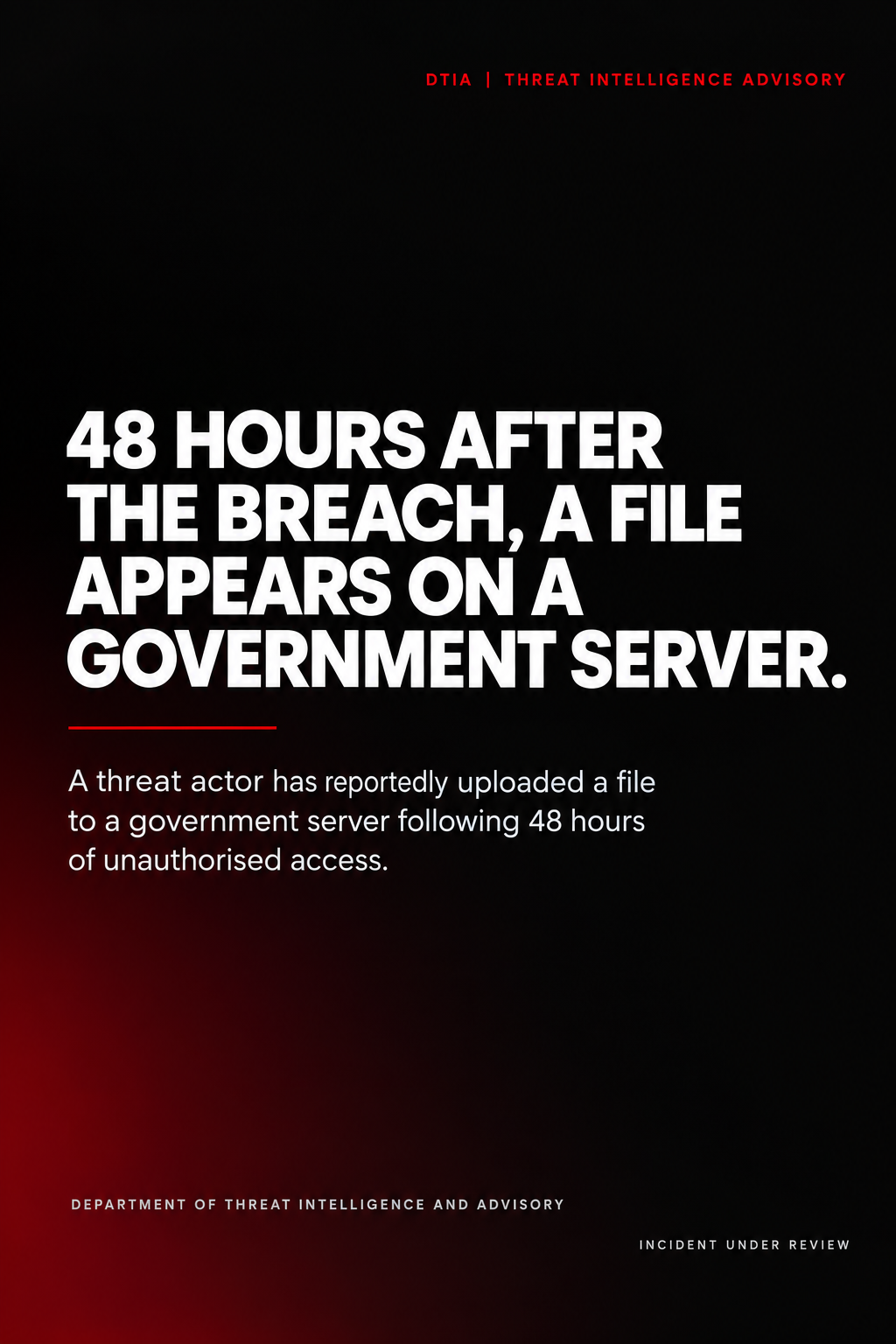
For 48 hours, federal systems remained entirely blind to unauthorized changes, exposing the fragile state of national cyber defenses against sophisticated threat actors.With the government unaware that a hostile file has been planted on its infrastructure,
This threat was detected by the Department of Threat Intelligence and Advisory a non governmental organisation responsible for global digital threat detection, intelligence and Advisory.
IT administrators and system operators must immediately shift to an emergency incident response posture. Waiting for routine, scheduled security audits is no longer an option when a live threat is active inside the perimeter.
Network defenders are facing a race against time, forced to operate under the assumption that the integrity of the entire system has already been deeply compromised.
The priority has rapidly shifted from everyday network maintenance to aggressive, active containment.The true danger of an undetected file placement lies in what happens immediately after the initial breach occurs.
In cybersecurity, an unauthorized file is rarely an isolated incident; it serves as a beachhead for a much larger, coordinated offensive. While defenses remain blind, attackers use this initial foothold to establish persistent backdoors, escalate their system privileges, and clear their digital tracks.
This quiet execution of unauthorized commands gives adversaries the time they need to map out the network structure.By the time federal authorities finally discover the rogue file, the attacker may have already pivoted from this single server into the wider national data network.
This process of lateral movement allows threat actors to migrate from low-security, public-facing infrastructure straight into high-value databases. Once inside the core network, the potential for damage multiplies exponentially. Adversaries can seamlessly access interconnected systems housing citizen data, financial records, and classified state intelligence.To combat this silent occupation of sovereign digital territory, the Department of Threat Intelligence and Advisory (DTIA) has advised an immediate overhaul of current defense behaviors.
IT operators are mandated to deploy real-time File Integrity Monitoring (FIM) solutions capable of triggering instant alerts the exact millisecond a file is altered or created. Additionally, aggressive threat-hunting protocols must be launched across all state agencies to actively sweep for hidden malware and rogue system processes.
Ultimately, this incident serves as a severe warning that digital sovereignty requires constant, real-time verification. A 48-hour delay in threat detection is an unacceptable vulnerability that places the nation’s critical infrastructure at extreme risk. Moving forward, the government must transition from a passive, defensive mindset to an active, zero-trust security architecture. Only by eliminating these visibility blind spots can the state reliably secure its digital vaults and protect national security from foreign and domestic cyber threats.
In the digital space, allowing an attacker to write a file to your server without detection is the equivalent of letting an intruder walk into a state vault, plant an unmarked package, and walk out unnoticed.
With the government unaware that a hostile file has been planted on its infrastructure, IT administrators and system operators must immediately shift to an emergency incident response posture
By the time the government discovers the file, the attacker may have already pivoted from this single server into the wider national data network.
Department of Threat Intelligence and Advisory