Introduction: Why comparing NDPA and GDPR matters for Nigerian businesses in 2026
Nigerian companies are scaling across Africa and serving customers in Europe via ecommerce, SaaS, and remote services. In 2026, understanding the NDPA vs GDPR differences for Nigerian businesses is no longer optional—it is core to customer trust, market access, and risk management.
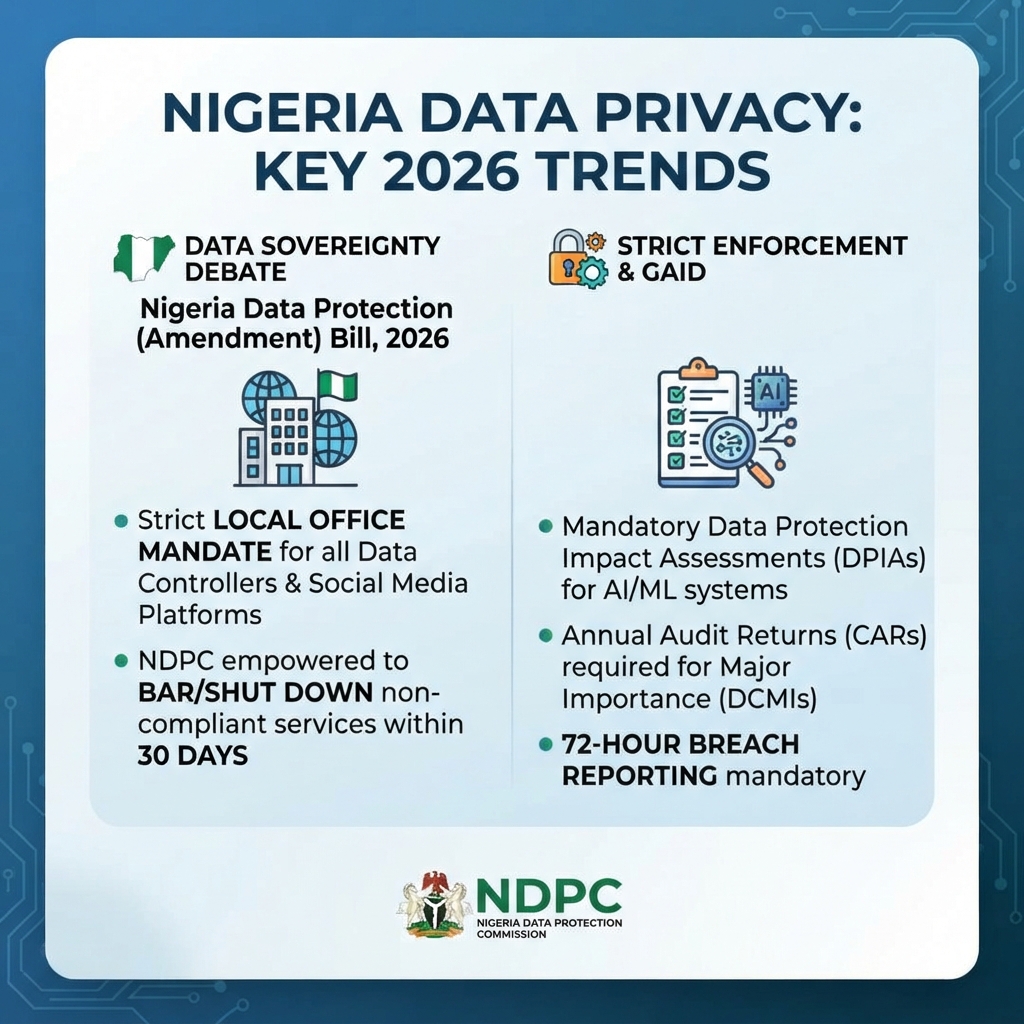
The Nigeria Data Protection Act 2023 (NDPA) is now firmly in force under the Nigeria Data Protection Commission (NDPC), while the EU’s General Data Protection Regulation (GDPR) remains the global benchmark privacy framework. Aligning with both ensures smoother cross-border data flows, cleaner vendor due diligence, and fewer surprises during audits or breach investigations.
Quick Summary: At-a-glance differences in scope, fines, and core obligations
- Scope: NDPA protects people in Nigeria and applies to controllers/processors in or targeting Nigeria. GDPR applies to EU establishments and to non-EU entities that target or monitor individuals in the EU.
- Fines: GDPR: up to €20m or 4% of global turnover (whichever is higher). NDPA: graduated penalties; for controllers/processors of major importance, up to the higher of NGN 10m or 2% of annual gross revenue; lower tiers face smaller caps and corrective orders.
- Legal bases: Both recognize consent, contract, legal obligation, vital interests, public interest, and legitimate interests (with safeguards).
- Rights timelines: GDPR: one month (extendable). NDPA: typically 30 days (extendable where justified).
- Governance: Both require accountability measures: DPO in defined cases, DPIAs for high risk, records of processing, and vendor contracts.
- Transfers: EU→Nigeria needs Article 46 safeguards (e.g., SCCs). Nigeria→EU requires NDPC-approved mechanisms or adequacy where designated.
Scope and Territorial Reach: When NDPA applies, when GDPR applies, and when both do
NDPA applies when a controller or processor operates in Nigeria, processes personal data of people in Nigeria, or targets services at individuals in Nigeria. It also captures vendors serving Nigerian clients if they handle Nigerians’ data on the client’s behalf.
GDPR applies when you are established in the EU or, while outside the EU, you offer goods/services to or monitor the behavior of individuals in the EU. Even a non-EU company is in scope if it targets EU users with localized offers, pricing in EUR, or EU-language campaigns.
- NDPA only: A Lagos clinic serving only Nigerian patients on local systems.
- GDPR only: A Paris-based SaaS with no Nigerian activity processes EU users’ data.
- Both: A Nigerian ecommerce site shipping to France and tracking EU visitors, or a Nigerian BPO processing EU customers’ data for an EU client.
See the European Commission’s overview of GDPR territorial scope and obligations here.
Legal Bases and Consent: Alignment, divergences, and special category data
Both frameworks recognize lawful bases including consent, contract, legal obligation, vital interests, public interest, and legitimate interests. Nigerian businesses should map each processing activity to one clear basis and document the reasoning.
- Consent: Must be specific, informed, and freely given, with easy opt-out. For marketing, consider GDPR-aligned consent practices and keep auditable logs.
- Legitimate interests: Useful for fraud prevention or internal analytics when privacy risks are minimized. Perform and record a legitimate interest assessment (LIA).
- Special category/sensitive data: Health, biometrics, genetics, religious or political views, sexual life, and children’s data demand stronger safeguards and a specific exemption (e.g., explicit consent, employment or public health law, vital interests when consent is impracticable).
Tip: Avoid mixing consent with contract. If a service is necessary, contract is often more sustainable than consent that can be withdrawn.
Data Subject Rights: Response timelines, verification, and common exemptions
Individuals have robust rights under both NDPA and GDPR: access, rectification, erasure, restriction, portability, objection, and limits on automated decisions.
- Timelines: GDPR requires a response within one month (extendable by two for complexity). NDPA commonly expects responses within 30 days, with reasonable extensions when justified.
- Verification: Always verify identity proportionately before releasing data. Keep records of request handling and decisions.
- Exemptions: Legal privilege, security and law-enforcement needs, and rights of others may limit disclosure. Document the basis and communicate clearly if you refuse or narrow a request.
Build a standardized rights-request workflow, including intake, triage, ID checks, system searches, redaction, and secure delivery.
Accountability and Governance: DPO, DPIA, records, audits, and vendor contracts
- DPO: Appoint a Data Protection Officer where required (e.g., controllers/processors of major importance, large-scale monitoring, or high-risk activities). The DPO can be internal or outsourced but must be independent and expert.
- DPIA: Conduct Data Protection Impact Assessments for high-risk processing (biometrics, geolocation tracking, profiling, large-scale sensitive data). Integrate DPIAs into product and vendor onboarding.
- Records of Processing (RoPA): Maintain structured inventories that link purposes, legal bases, recipients, retention, and transfer mechanisms.
- Vendor contracts: Use data processing agreements with security, sub-processor approval, assistance with rights, and deletion/return on termination.
- Audits and training: Run periodic privacy audits, role-based training, and executive reporting to demonstrate ongoing compliance.
Cross-Border Transfers: Adequacy, standard clauses, and safeguards for Nigeria–EU flows
EU → Nigeria: The EU has not granted Nigeria an adequacy decision. Use Article 46 safeguards—most commonly Standard Contractual Clauses (SCCs)—plus supplementary measures (encryption, access controls) and a transfer impact assessment following the post-Schrems II expectations. See the Commission’s international transfers guidance here.
Nigeria → EU: NDPA permits outbound transfers where the destination has adequate protection or where appropriate safeguards exist (e.g., NDPC-approved standard clauses, binding corporate rules, or explicit consent with protections). Keep a transfer register and re-evaluate vendors after material legal changes.
Practical tips:
- Map data flows and vendor locations; avoid accidental routing through non-compliant regions.
- Adopt end-to-end encryption and role-based access to minimize exposure.
- Align incident response, logging, and retention with transfer commitments.
Enforcement and Penalties: Regulators, fines, investigations, and breach reporting
Regulators: NDPA is enforced by the Nigeria Data Protection Commission (NDPC). GDPR is enforced by independent EU data protection authorities (DPAs) with cross-border cooperation mechanisms.
Fines: GDPR administrative fines reach up to €20m or 4% of global turnover. NDPA uses tiered penalties, including the higher of NGN 10m or 2% of annual gross revenue for controllers/processors of major importance, as well as remedial orders, warnings, and suspension of processing for others.
Breach reporting: Notify authorities and, where risk is high, affected individuals without undue delay. GDPR requires notification within 72 hours of awareness where feasible; NDPA follows similar prompt-notice principles. Maintain logs, evidence, and post-incident reviews. For the business impact of breaches, see this overview from Forbes.
Compliance Roadmap: Practical steps for dual-compliance in 2026
- 1) Map your data: Build a living data inventory and RoPA covering systems, purposes, legal bases, retention, and transfers.
- 2) Gap assessment: Benchmark current controls against NDPA and GDPR; prioritize high-risk gaps and revenue-impacting use cases.
- 3) Lawful bases & notices: Assign legal bases per process; refresh privacy notices, cookie banners, and consent flows.
- 4) Governance: Appoint a DPO if required; define roles, escalation paths, and board reporting.
- 5) DPIAs & security: Run DPIAs for high-risk activities; harden security (encryption, access controls, monitoring, vendor risk).
- 6) Vendor management: Standardize DPAs, SCCs, and periodic audits; maintain a transfer register and TIAs.
- 7) Rights & incident playbooks: Implement request-handling SLAs and 72-hour breach procedures; test with tabletop exercises.
- 8) Training & culture: Deliver role-based training to marketing, engineering, HR, and sales; measure with KPIs.
Conclusion: Build a unified privacy program that satisfies both frameworks
Rather than manage two separate regimes, design a unified privacy program that meets the strictest common denominator of NDPA and GDPR. This reduces operational friction, accelerates EU market entry, and builds durable customer trust.
Prioritize data mapping, lawful bases, transfers, and strong vendor governance. With sound documentation and a trained team, Nigerian businesses can scale confidently across borders while staying compliant in 2026 and beyond.
FAQs: Do Nigerian SMEs need GDPR, data localization, age of consent, fines caps, lawful basis examples
Do Nigerian SMEs need to comply with GDPR?
If you offer goods/services to people in the EU or monitor EU users (e.g., EU-targeted ads, pricing in EUR, or localized EU pages), GDPR applies—regardless of company size.
Does NDPA require data localization in Nigeria?
No general localization mandate. Cross-border transfers are allowed with adequacy or appropriate safeguards approved or recognized by the NDPC.
What is the age of consent for data processing?
GDPR sets 16 for children’s consent to online services, with EU countries allowed to lower it to 13–16. Under NDPA, children’s data receives heightened protection, and parental/guardian authorization is generally required for services directed at minors—consult NDPC guidance for your specific context.
What are the maximum fines?
GDPR: up to €20m or 4% of global annual turnover (whichever is higher). NDPA: tiered penalties; for controllers/processors of major importance, up to the higher of NGN 10m or 2% of annual gross revenue, with lower tiers facing smaller caps and corrective measures.
Examples of lawful bases for common activities?
- Customer onboarding: Contract
- Invoicing & tax: Legal obligation
- Service emails: Contract or legitimate interests
- Marketing emails: Consent (with easy opt-out) or legitimate interests with an LIA and robust unsubscribe
- Fraud detection: Legitimate interests or vital interests in emergencies
For foundational background, see the GDPR overview and Nigeria’s data protection authority resources (e.g., the NDPC).