Introduction: What the NDPA Is and Why It Matters in Nigeria
If you have been asking what is the Nigeria Data Protection Act NDPA, here is the short answer: it is Nigeria’s comprehensive data protection law enacted in 2023 to safeguard personal data, build trust in the digital economy, and align the country with global privacy standards. The Act created the Nigeria Data Protection Commission (NDPC) as the national regulator and replaced the earlier 2019 NDPR framework.
For Nigerian organizations, the NDPA matters because it sets clear rules on how to collect, use, store, share, and secure personal data. It strengthens individual rights, introduces strict obligations for controllers and processors, and empowers the NDPC to investigate violations and impose fines. In practical terms, NDPA compliance is now a core business requirement, essential for reputation, customer trust, and cross-border trade.
Learn more background on data protection concepts via Wikipedia, and consult the Nigeria Data Protection Commission (NDPC) for official updates.
Quick Summary: NDPA at a Glance — Scope, Key Duties, Rights, and Penalties
- Scope: Applies to organizations in Nigeria and those outside Nigeria that process personal data of individuals in Nigeria.
- Key duties: Identify a lawful basis, follow core processing principles, secure data, manage vendors, and maintain records.
- Individual rights: Access, rectification, erasure, restriction, portability, objection, consent withdrawal, and safeguards against automated decisions.
- Cross-border transfers: Allowed with adequacy, appropriate safeguards (e.g., contractual clauses, BCRs), or limited derogations.
- Enforcement: NDPC can audit, issue compliance orders, suspend processing, and levy fines.
- Penalties: For controllers/processors of major importance, up to the higher of NGN 10M or 2% of annual gross revenue; for others, up to the higher of NGN 2M or 2% (as prescribed by the Act and NDPC regulations).
Who the NDPA Applies To: Controllers, Processors, and Sectors Covered
The NDPA applies to data controllers (who determine purposes and means of processing) and data processors (who process data on behalf of controllers). It cuts across sectors including fintech, banking, telecoms, healthtech, education, logistics, hospitality, e-commerce, and the public sector.
Its reach is extraterritorial: foreign entities offering goods or services to people in Nigeria, or monitoring their behavior, fall within scope. The NDPC may designate “controllers or processors of major importance” due to scale or impact; such organizations face enhanced duties like registration and heightened penalties.
SMEs are not exempt: obligations scale with risk, but any business handling personal data must implement reasonable, proportionate safeguards.
Core Principles of Processing: Lawfulness, Fairness, Transparency, and Minimization
The NDPA’s principles guide every processing activity and inform compliance decisions:
- Lawfulness, fairness, transparency: Be honest with individuals, provide clear notices, and rely on a valid legal basis.
- Purpose limitation: Collect for specific, explicit purposes and avoid incompatible reuse.
- Data minimization: Limit data to what is adequate, relevant, and necessary.
- Accuracy: Keep information current; correct or delete inaccuracies promptly.
- Storage limitation: Retain only for as long as needed; apply clear retention schedules.
- Integrity & confidentiality: Use appropriate technical and organizational security measures.
- Accountability: Be able to demonstrate compliance through policies, records, and audits.
Lawful Bases & Consent Under the NDPA: Practical Examples for Nigerian Organizations
Every processing activity needs a lawful basis. Common options mirrored from global standards include:
- Consent: A retailer sends promotional SMS only after clear opt-in; customers can easily opt-out.
- Contract: An e-commerce site processes delivery details to fulfill a purchase order.
- Legal obligation: A bank retains KYC/AML records to meet statutory requirements.
- Vital interests: A clinic shares emergency data to protect a patient’s life.
- Public interest/official authority: A public agency processes data to deliver mandated services.
- Legitimate interests: A fintech uses basic analytics to prevent fraud, balancing against user rights.
Consent must be freely given, specific, informed, and unambiguous (explicit for sensitive data). Avoid bundled or forced consent, document how and when consent was obtained, and provide simple withdrawal mechanisms across web, app, and SMS channels.
For children’s data, obtain appropriate parental/guardian consent and design age-appropriate notices.
Data Subject Rights: Access, Rectification, Erasure, Portability, and Objection
Individuals have strong rights under the NDPA. Build clear processes to authenticate requests and respond within statutory timelines.
- Access: Provide a copy of personal data and key processing information.
- Rectification: Correct inaccurate or incomplete records promptly.
- Erasure: Delete data where required (e.g., consent withdrawal, no overriding basis).
- Restriction: Temporarily limit processing during disputes or verification.
- Portability: Supply data in a structured, commonly used format where applicable.
- Objection: Respect objections to direct marketing and evaluate other objections on a case-by-case basis.
- Automated decisions: Provide safeguards where decisions are made solely by automated means with significant effects.
Maintain a request log, standard response templates, and escalation paths to your DPO or privacy lead.
Controller and Processor Obligations: Records, DPIAs, Security, DPO Requirements
- Records of Processing (RoPA): Maintain up-to-date inventories of processing activities, lawful bases, recipients, and retention periods.
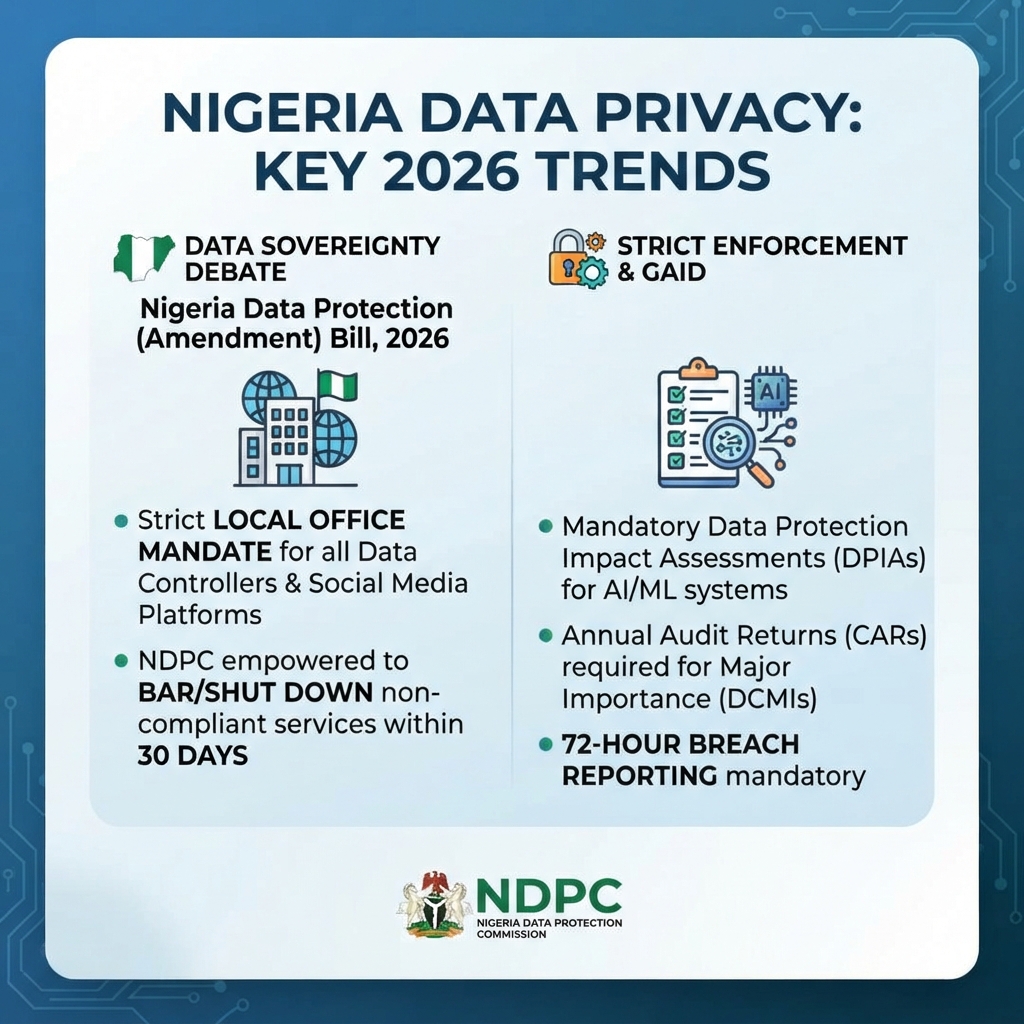
- DPIAs: Conduct Data Protection Impact Assessments for high-risk processing such as large-scale profiling, sensitive data, children’s services, geolocation tracking, or new technologies.
- Security: Apply encryption, access control, logging, network security, backups, and secure development practices; train staff and test incident response.
- Breach notification: Notify the NDPC and affected individuals without undue delay (generally within 72 hours where feasible) when a breach is likely to result in risk or high risk.
- DPO: Appoint a Data Protection Officer where required (e.g., public bodies, large-scale monitoring/sensitive data, or where designated as a controller/processor of major importance). Ensure independence, expertise, and direct reporting lines.
- Processor management: Use data processing agreements, vet vendors, and monitor compliance through audits and SLAs.
Cross-Border Data Transfers: Adequacy, Safeguards, and Contractual Clauses
Personal data can leave Nigeria only with appropriate protections:
- Adequacy: Transfer to countries or sectors the NDPC deems to provide an adequate level of protection.
- Appropriate safeguards: Use tools like Standard Contractual Clauses (SCCs), Binding Corporate Rules (BCRs), approved codes of conduct, or certifications with enforceable rights.
- Derogations: Rely on limited exceptions such as explicit consent, contract performance, public interest, legal claims, or vital interests.
Map your data flows, run transfer risk assessments, and implement technical measures (e.g., encryption, key management) alongside contractual protections. For comparative context, see how similar mechanisms work under the EU GDPR.
Enforcement, Fines, and Real-World Scenarios: How NDPC Applies the Law
The NDPC has powers to investigate, audit, order remediation or suspension of processing, and impose monetary penalties. Regulatory focus often falls on security lapses, unlawful marketing, inadequate notices, and poor vendor oversight.
- Fines: For controllers/processors of major importance, up to the higher of NGN 10M or 2% of annual gross revenue; others up to the higher of NGN 2M or 2% (subject to NDPC guidance).
- Scenario — Fintech: A startup that profiles customers without a lawful basis or DPIA may face an audit, mandated changes, and fines.
- Scenario — Healthtech: A clinic that emails unencrypted lab results to the wrong patient could trigger breach notifications and sanctions.
- Scenario — Marketing: Bulk SMS without consent leads to enforcement action, requiring opt-out mechanisms and proper consent records.
Expect the NDPC to prioritize high-risk sectors, children’s data, and cross-border transfers lacking safeguards.
Actionable Compliance Checklist and Official Resources
- Map data: Catalog what you collect, why, where it’s stored, retention, and recipients.
- Choose lawful bases: Document the basis for each processing activity; refresh consent flows.
- Update notices: Publish clear, layered privacy notices tailored to web, app, and offline channels.
- Tighten security: Enforce MFA, encryption, patching, backups, and vendor access controls.
- Contracts: Put data processing clauses in place with all processors; set DPAs and SLAs.
- DPIAs: Perform and record assessments for high-risk projects before launch.
- Train staff: Run role-based privacy training and phishing simulations.
- Appoint a DPO: Where required; publish contact details and empower the role.
- Incident response: Build a 24/7 plan for detection, investigation, notification, and lessons learned.
- Cross-border: Implement SCCs/BCRs and run transfer risk assessments.
- Registration (if applicable): Follow NDPC rules for controllers/processors of major importance.
Helpful resources: NDPC (official site), GDPR overview (Wikipedia), and privacy policy guidance (HubSpot).
Conclusion: Your Next Steps to NDPA Readiness
The Nigeria Data Protection Act is now a strategic requirement for every data-driven organization. Begin with a gap assessment, prioritize high-risk activities, and build a sustainable privacy program that scales with your growth.
Establish governance (DPO, policies, RoPA), embed privacy by design into products, and demonstrate accountability through audits and metrics. Strong NDPA compliance enhances customer trust and opens doors for partnerships and cross-border opportunities.
FAQ: Common NDPA Questions for Nigerian Businesses
- Is the NDPA different from the NDPR? Yes. The NDPA (2023) is a comprehensive statute that supersedes the 2019 NDPR and establishes the NDPC as the regulator.
- Does the NDPA apply to foreign companies? Yes, if they offer goods/services to people in Nigeria or monitor their behavior.
- Do SMEs need a DPO? Only where required by risk/scale or NDPC designation. Many SMEs still benefit from assigning a privacy lead.
- What counts as sensitive data? Categories like health, biometric, genetic, sexual life, political opinions, religious beliefs, trade union membership, and similar high-risk attributes.
- Can we use WhatsApp or email for HR data? Yes, but apply strict access controls, encryption, retention limits, and policy guidance.
- Do we have to register with the NDPC? Controllers/processors of major importance may need to register per NDPC rules. Check official guidance.
- How fast must we report breaches? Without undue delay; where feasible, within 72 hours for incidents likely to pose risk or high risk.
- Can we do marketing without consent? You may rely on legitimate interests if appropriate safeguards exist, but unsolicited electronic marketing typically requires clear opt-in and an easy opt-out.
When in doubt, consult the NDPC or qualified counsel for context-specific advice.